
Scope
This resource covers the load-bearing insulation materials used in Pipe Shields pre-insulated pipe supports: calcium silicate, polyurethane foam, Foamglas®, and Super Fire Temp. It defines:
- the function of support insulation
- the properties and service temperature range of each material
- the components of a pre-insulated support assembly
Combined, the four materials cover service temperatures from –450°F to +1700°F.
Function of Support Insulation
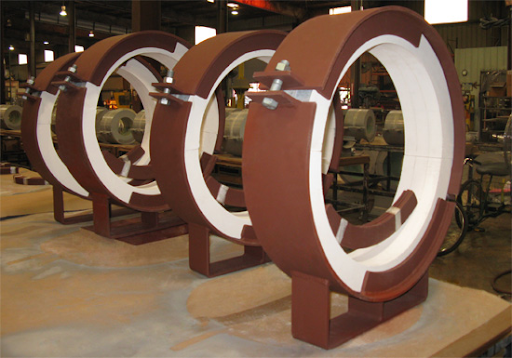
A pre-insulated pipe support places load-bearing insulation at the point where the pipe meets the support. The insulation serves two functions: it limits heat transfer at the support and carries the pipe load.
Standard pipe insulation is not designed to carry load. At the support point, insulation is compressed between the pipe and the supporting structure and must resist crushing under the pipe weight.
Without support insulation, the support becomes a thermal bridge. Thermal bridging occurs when a conductive component, such as a metal pipe clamp or shoe, is in direct contact with both the pipe and the structure. Its effects depend on the service:
- Hot service: heat loss and wasted energy. Under the Manufacturers Standardization Society (MSS) code, steel supports lose 100°F per inch, measured from the outer wall of the pipe.
- Cold and cryogenic service: increased energy consumption to re-cool the fluid, and condensation, which causes Corrosion Under Insulation (CUI).
- Exposed surface temperature: on hot lines, exposed surfaces must remain below the maximum temperature permitted by plant safety requirements.
Insulation efficiency tends to be inversely related to compressive strength. Thermal energy is transferred through molecular collisions, so denser materials, in general, transmit more thermal energy. Support insulation must provide the compressive strength required by the load while limiting heat transfer.
Insulation Placement
Support insulation is installed in one of two positions:
- Between the pipe and the support – The insulation surrounds the pipe within the support, eliminating metal-to-metal contact between the support and the pipe.
- Between the support and the structure – The support attaches directly to the pipe, and the insulation separates the support from the supporting steel or concrete.
In either position, the design must account for:
- temperature limits
- energy to be dissipated
- condensation control
- exposed surface temperatures
- cost and available space
- the long-term load-carrying capacity of the insulation
Material Selection Parameters
Insulation material is selected by evaluating four parameters together:
- Service temperature – The operating temperature of the line must fall within the rated range of the material.
- Load – The compressive strength of the insulation must suit the load at the support point. Standard grades range from 100 psi (calcium silicate) to 500 psi (20 pcf polyurethane).
- Environment – Moisture absorption affects thermal performance and corrosion at the support.
- Movement – Expected vertical, lateral, and axial movement at the support point is a design input to support selection.
When no single material satisfies both the temperature and the load requirement, a composite insulation design is used.
Calcium Silicate (Thermo – 1200/Gold)
Calcium silicate (Thermo-1200/Gold) is the standard insulation for high-temperature pre-insulated pipe supports. It is an insulating material composed of hydrous calcium silicate. Pipe Shields uses a 14 pcf (pounds per cubic foot) grade with a compressive strength of 100 psi.
Properties:
- Service temperature: +40°F to +1200°F
- Density: 14 pcf
- Compressive strength: 100 psi
- Water absorption: less than 15%
- Fire resistant
- Low chloride content and low corrosivity
- Asbestos-free
Polyurethane Foam
High-density polyurethane foam (PUF) is the standard insulation for cold and cryogenic pre-insulated pipe supports. The published service range is –275°F to +275°F. Supports can be engineered for service down to –325°F.
The load capacity of polyurethane foam is commonly adjusted by changing its density. Strength is also influenced by the catalyst, surfactant, mixing method, and foaming system.
| Density (pcf) | Compressive strength (psi) | Water absorption (%) |
| 10 | 200 | 0.22 |
| 14 | 300 | 0.18 |
| 20 | 500 | 0.13 |
| 35 | Available on request | — |
All standard grades have 95% closed-cell content. Piping Technology & Products (PT&P), the parent company of Pipe Shields, produces polyurethane in-house. Polyurethane is anisotropic: it is stronger in the direction of foam rise.
Foamglas®
Foamglas® has the widest service temperature range and is used in both cryogenic and hot service. It is a lightweight, rigid insulating material composed of millions of completely sealed glass cells.
Properties:
- Service temperature: –450°F to +900°F
- Density: 8 pcf
- Compressive strength: 400 psi
- Water absorption: 0.07%
- Fire protection
- Corrosion resistance
- Long-term dimensional stability
Moisture cannot penetrate the sealed glass cells in liquid or vapor form. Properly installed Foamglas® retains its original thermal efficiency long term.
Use at the load point – Foamglas® is not used alone at the load point of heavy-duty supports. At the load point, it is combined with a load-bearing material:
- Cold service: polyurethane
- Hot service: calcium silicate or Super Fire Temp high-density structural inserts
Super Fire Temp
Super Fire Temp is a high-temperature insulation material in the Pipe Shields range. Its service temperature range of +40°F to +1700°F extends 500°F above calcium silicate. It is a high-density material used as a structural insert at the load point of hot-service supports. The insert carries the pipe load, and the surrounding insulation limits heat transfer.
Support Assembly Components
The Pipe Shields glossary defines the two components that work with the insulation:
- Insert: the insulation material, usually of higher compressive strength, joined to the existing insulation to reinforce the pipe support.
- Protection shield: the metallic component wrapped directly around the insulation, which keeps the assembly intact and protects the insulation.
The B1000 sliding support lists the following material data:
| Component | Material |
| Insulation | Asbestos-free calcium silicate, treated with water repellent |
| Structural inserts | High-density, asbestos-free calcium silicate, treated with water repellent, for load transfer |
| Jacket | Overlapping galvanized steel sheet metal, ASTM (American Society for Testing and Materials) A-527 |
| Glue | Industrial contact adhesive |
| Base and straps | Carbon steel, ASTM A-36 |
| Slide pad | UHMW (ultra-high-molecular-weight) polyethylene; PTFE (polytetrafluoroethylene) optional |
Jacket gauge increases with pipe size. On the A1000, the jacket is 24 gauge for 1/2-inch to 1-1/2-inch pipe and 16 gauge for 12-inch to 24-inch pipe.
Material Selection by Service Temperature
| Line temperature | Materials rated for the range |
| –450°F to –275°F | Foamglas® |
| –275°F to +40°F | Polyurethane, Foamglas® |
| +40°F to +275°F | Polyurethane, Foamglas®, calcium silicate, Super Fire Temp |
| +275°F to +900°F | Foamglas®, calcium silicate, Super Fire Temp |
| +900°F to +1200°F | Calcium silicate, Super Fire Temp |
| +1200°F to +1700°F | Super Fire Temp |
Where more than one material is rated for the service temperature, final selection is based on load, environment, and movement.
Pipe Shields Product Series
| Series | Support type | Application |
| A1000–A9000 | Commercial and light industrial | Smaller loads and movements; commonly used on chilled and heated water systems |
| B1000–B8300 | Base mounted | Larger vertical and lateral loads and movements; supports the pipe from below |
| C1000–C4300 | Pipe anchors | Larger multi-directional loads and movements; restrains movement of the piping system |
| D1000–D6300 | Hanger type | Larger loads and movements; supports the pipe from above with one or two hanging rods |
| E1000–E2300 | Insulated pipe riser clamps | Supports the pipe in a vertical riser configuration |
| G1000–G3000 | Pipe clamps, guide straps, guide U-bolts | Clamping hardware, typically used with A1000- A9000 supports |
Series selection by support configuration is covered in How Configuration Determines Your Pipe Support Model.
Frequently Asked Questions
Q: What insulation materials are used in pre-insulated pipe supports?
A: Pipe Shields uses calcium silicate, high-density polyurethane foam, Foamglas®, and Super Fire Temp. Combined, the materials cover service temperatures from –450°F to +1700°F.
Q: Why is standard pipe insulation not used at the support point?
A: Standard pipe insulation is not designed to carry load. Support insulation must carry the pipe weight without crushing while limiting heat transfer.
Q: Which insulation is used for cryogenic service?
A: Polyurethane foam is standard, rated –275°F to +275°F. Foamglas® is rated to –450°F and is combined with polyurethane at the load point.
Q: What do the U, UF, and CF suffixes designate?
A: U designates polyurethane, UF designates polyurethane with Foamglas®, and CF designates calcium silicate with Foamglas®. The suffix follows the catalog model number.
Q: Are load ratings affected by service temperature?
A: Yes. A1000 calcium silicate load ratings are multiplied by 0.90 at 500°F, 0.75 at 750°F, 0.50 at 1000°F, and 0.30 at 1200°F.
Q: Which material is rated for the highest service temperature?
A: Super Fire Temp, rated +40°F to +1700°F, used as a high-density structural insert at the load point of hot-service supports.
Application Support
Material selection depends on the full set of design inputs at each support point: pipe size, service temperature, insulation thickness, load, support configuration, and movement. These inputs are described in What Information Do You Need to Order a Pre-Insulated Pipe Support? Connect with our team to review an application, or request a quote.
