
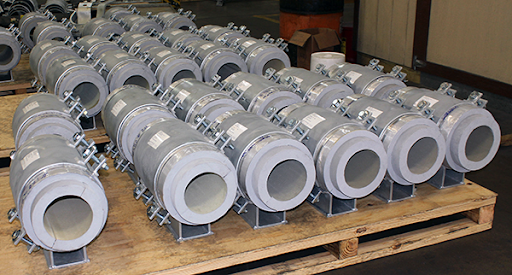
Selecting the correct pre-insulated support involves matching the support type to the temperature and load requirements of your application. “Matching” is the operative word; a pre-insulated support isn’t ordered by pipe size alone. It’s checked against a specific product line, a Selection Guide table, or a particular model page, and each of those is built around six values:
- Pipe size
- Temperature
- Insulation thickness
- Load
- Support configuration
- Movement
If even one value is missing from the RFQ, there’s no table or model to check it against yet. That’s the core problem Pipe Shields frames in its guide on how to choose a pre-insulated pipe support.
This article walks through these six values and points to where each one typically lives in your own project documents, so you can pull together a complete RFQ on the first attempt instead of a back-and-forth.
Why the Support Sits Outside the Insulation in the First Place
Before getting into the six parameters, it’s worth being precise about what a pre-insulated support is actually solving, because it explains why each parameter matters rather than being a formality.
In Top 3 Benefits of Pre-Insulated Pipe Supports, Pipe Shields describes the failure mode of a conventional clamp-then-wrap installation this way: thermal bridging happens “when a highly conductive material, like a metal pipe clamp or shoe, comes into direct contact with both the pipe and the building structure.”
The consequence differs by service: in hot systems, “heat is lost, leading to wasted fuel/energy,” and in cold or cryogenic systems, it causes “increased energy consumption to re-cool the fluid and, worse, condensation (sweating), which causes Corrosion Under Insulation (CUI).”
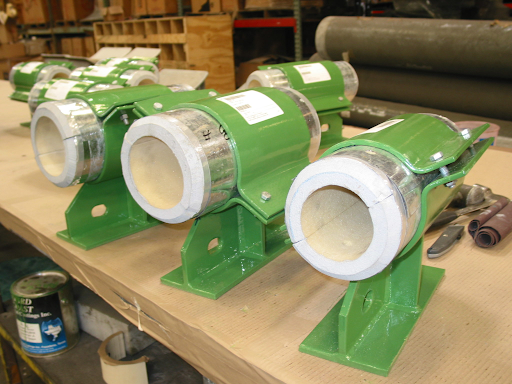
A pre-insulated support replaces that direct metal-to-metal contact with “high-density, load-bearing insulation materials, such as Calcium Silicate or Polyurethane, that are factory-fabricated and integrated with the outer metal shield”, which is exactly why the shield has to be specified to the same temperature, thickness, and load conditions as the line it’s protecting.
The Six Parameters an RFQ Needs
1. Pipe Size
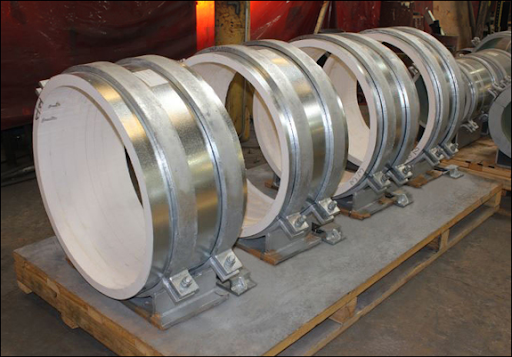
Pipe size is the first filter because it sets which model group within a series applies. On the Commercial and Light Industrial (A-series) line and the Hanger Type (D-series) line, the size range narrows as the duty level goes up:
- A-series, lighter/medium duty groups: 1/2″ – 24″
- A-series, medium/heavy and heavy-duty groups: 2-1/2″ – 42″
- A-series, heaviest-duty models: 6″ – 42″ or 10″ – 30″,depending on the model number
- D-series, 2-bolt and 2-rod hanger groups (D1000–D2000, D4000–D5000): 1/2″ to 4″
- D-series, mid-size 2-bolt group (D3000–D3300): 1″ to 42″
- D-series, largest 2-rod hangers (D6000–D6300): 5″ to 30″ up to 20″ to 30″ on the heaviest model
2. Service / Operating Temperature
Temperature determines which insulation material and which product family apply. Across the A1000 and D5000 product pages, the Hot Pipe Shoe Support Specifications bulletin, and the Cryoshoes Support Specifications bulletin, the tiers break down as follows:
- Standard, calcium-silicate insulated (A1000, D5000): +40°F to +1200°F CalSil Insulation, with higher temperatures “available upon request”
- Hot Pipe Shoe design range: 40°F (4.4°C) to 1800°F (982°C) at the pipe surface, with ambient temperature capped at 140°F (60°C) above design condition and outside jacket surface limited to 120°F under that ambient condition
- Urethane-insulated “U” variant (A1000U, D5000U), moderately cold service: -275°F to +275°F
- Cryoshoes, deep cryogenic service, listed on the quote form as PT&P Cold Shoes (CS1000 through CS6000): – 460 °F (-273 ˚C) to 280 ˚F (138 ˚C)
3. Insulation Thickness
Insulation thickness is specified as a dimension on the model, not a single universal number:
- A1000: insulation dimension (“Dimension A”) ranges from 4″ to 18″ depending on pipe size, paired with a sheet-metal jacket gauge ranging from 16 to 24 gauge
- D5000: thickness is offered as four discrete options – 1″, 2″, 3″, and 4″, again tied to pipe size
Since the support’s insulation has to sit flush with the field-applied insulation on the rest of the line, this value has to be supplied, not assumed.
4. Load
Load ratings are published per model and derated with temperature:
- A1000 maximum ratings: 35 lbs (½” pipe, flat surface mounting) up to 2000 lbs (20″ pipe, clevis hanger mounting)
- Temperature de-rating factor: Runs from 0.9 at 500°F down to 0.3 at 1200°F
- Hot Pipe Shoe design requirements: A minimum safety factor of 3 at the system design temperature, coefficient of friction limited to .1, plus a maximum deformation allowance of 1/32″ permanent consolidation and an additional 1/32″ of non-permanent deformation
- Cold Pipe Shoe/Cryoshoes design requirement: For cold and cryogenic service, the support has to be designed to withstand at least 5 times the actual load at the system’s design temperature
5. Support Configuration
Configuration decides which series applies before size or temperature narrows it further. Pipe Shields describes its six product series this way on its products page:
- A-Series – For smaller loads and movements. Commonly used on chilled and heated water systems. Most popular with mechanical contractors.
- B-Series (Base Mounted) – For larger loads (vertical and lateral) and movements. Supports the pipe from below. Commonly used in heavy industrial and large HVAC distribution systems.
- C-Series (Pipe Anchors) – For larger multi-directional loads and movements. Supports the pipe from below. Restrains the movement of the piping system.
- D-Series (Hanger Type) – For larger loads and movements. Supports the pipe from above (with one or two hanging rods). Used in heavy industrial and large HVAC applications.
- E-Series (Riser Clamps) – For both smaller and larger loads and movements. Supports the pipe in a vertical ‘riser’ configuration. For commercial, light and heavy industrial and large HVAC distribution systems.”
- G-Series (Pipe Guides) – Misc. pipe clamping hardware (typically used in conjunction with Pipe Shields A1000 through A9000 series insulated supports).
Within the D-series, models D1000–D3300 are built as 2-bolt hangers and D4000–D6300 as 2-rod hangers. Mounting itself is also a named variable, Pipe Shields’ own Selection Guide is organized as six tables crossing “Water Service” or “Steam, Gas, or Air Service” against three mounting conditions:
- Pipe supported from below (on a flat surface)
- Pipe supported from above (in clevis or 2-bolt hanger)
- Pipe supported from below (on pipe roll).
Which table applies to your line determines the model family before load or size does.
6. Expected Movement
Movement is treated as a design input, not a fixed property of the support. The Cryoshoes bulletin linked above lists “Vertical, lateral and axial support design load limits” and “Vertical, lateral, and axial support design travel limits” as separate values to be “considered in the selection.”
For hanger-mounted lines, Pipe Shields’ bulletin on support assembly components notes that “a designer may choose from a variety of clevis hangers, roller hangers, and adjustable bands to support the pipe” specifically to accommodate that movement, and that where vibration or dynamic loading is present, “hold-downs dampen these forces by transferring them to the supporting structure and thus protect the piping system.”
Where standard clamp materials can’t take the combination of temperature and movement, Pipe Shields notes that it can “fabricate clamps from alloy steels for high-temperature applications in which standard clamps are not adequate.”
RFQ Checklist
Before submitting a request, you should be able to state, for each support location:
- Pipe size (nominal or O.D., per the model’s stated range)
- Service temperature (standard CalSil range, urethane “U” range, or Cryoshoes range)
- Insulation thickness (or let the model’s stated dimension apply)
- Load at that point (with the applicable safety factor: 3 for hot service, 5 for cryogenic)
- Support configuration (Water vs. Steam/Gas/Air service, and from-above/from-below-flat/from-below-pipe-roll mounting, per the Selection Guide)
- Expected vertical, lateral, and axial movement at that point
Submitting the RFQ
Pipe Shields’ Request a Quote form is organized around the same series structure covered above, so identifying the right category is itself one less back-and-forth once the six values are in hand:
- Commercial and Light Industrial (A1000–A9000)
- Base Mounted (B1000–B8300)
- Pipe Anchors (C1000–C4300)
- Hanger Type (D1000–D6300)
- Insulated Pipe Riser Clamps (E1000–E2300)
- Pipe Clamps/Guide Straps/Guide U-Bolts (G1000–G3000)
For projects that need more than a standard model, the Cryoshoes bulletin notes that “design calculations, stress analyses, mill test reports, and material certifications” are “available upon request prior to order placement,” and the D5000 page notes “Formal Submittal Sheets Available” for hanger-type orders.
Still working through the details on your project? Connect with our team to talk through your specific application, or go ahead and request a quote once you have your six values in hand. The same page also handles 24/7 quick-turn emergency requests for urgent fabrication needs.
