How Configuration Determines Your Pipe Support Model

September 24, 2026

Overview

The entire Pipe Shields selection guide branches on two questions: what the service is and how the pipe is held. This article covers the three support configurations, the loads each one places on the insulation, and how each maps to the A, B, C, D, E, and G series. Readers will be able to answer the two questions that narrow the catalog from dozens of models to a handful. 

A1000 flat surface support
B1000 base mounted support

Picking a pre-insulated pipe support model comes down to two questions: what the service is, and how the pipe is held. Pipe Shields’ Selection Guide sorts every support by two variables: Service (Water or Steam/Gas/Air) and Configuration (how the pipe is held). Those two variables produce six tables, one pair of tables per configuration, split further by service. Configuration decides which pair of tables applies, and that decides which series are eligible at all. Service then decides which single table within that pair applies: Water, or Steam/Gas/Air. 

💡 Configuration selects the eligible support series; service decides the applicable pipe support table.

The letters are Pipe Shields’ product line names: A-series is Commercial and Light Industrial supports, B-series is Base Mounted supports, C-series is Pipe Anchors, D-series is Hanger Type supports, E-series is Insulated Pipe Riser Clamps, and G-series is Pipe Clamps, Guide Straps, and U-Bolts.

Switching a line from water to steam never changes which series apply. A B-series model doesn’t become eligible for a hanger job because the service changed, and a D-series model doesn’t become eligible for a pipe-roll job either. Configuration decides which series you’re choosing from; service doesn’t. That’s why configuration comes first. 

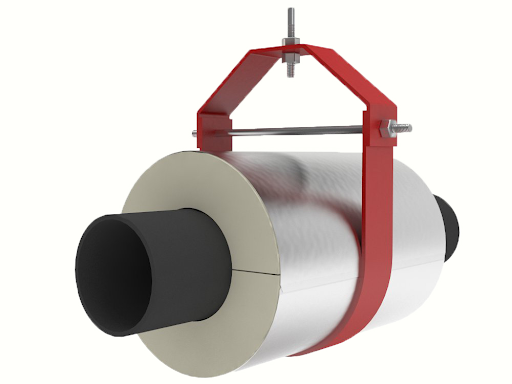
D5000 two rod hanger
D5000 two-rod hanger

The Three Configurations in the Selection Guide

  1. Supported From Below On A Flat Surface – This configuration uses Table 1 for water service and Table 2 for steam, gas, or air service. It includes A-series models A1000–A7400 and B-series models B1000–B8300.
  2. Supported From Above In A Clevis Or 2-Bolt Hanger – This arrangement uses Table 3 for water service and Table 4 for steam, gas, or air service. The listed options include A-series models A1000–A9000 and D-series models D1000–D6300. The D-series is the dedicated hanger-type line.
  3. Supported From Below On A Pipe Roll – This arrangement uses Table 5 for water service and Table 6 for steam, gas, or air service. The guide lists A-series models A3000–A8400 for this configuration; B- and D-series models are not included.
C4000 positive anchor

Fourth Configuration: Anchored Points

The six selection tables size a support to carry the pipe’s weight. Some points in the stretch of pipe need to be fixed against axial movement instead, and Pipe Shields handles this with the separate C-series pipe anchor line. The C-series splits into mounting and insulation. Welded anchors (C1000–C2100, up to 30″, uninsulated) bolt or weld straight onto the structure. Friction anchors (C3000–C3300, ½″–42″) and positive anchors (C4000–C4300, 1″–42″) both sit on a flat surface instead, and both come insulated. The positive anchor is even built to the same bottom-of-pipe height as a B-series support, so the two line up when they’re used on the same stretch.

E1000 riser claxmp
E1000 riser clamp

Fifth Configuration: Vertical Risers

The six selection tables cover horizontal piping. Vertical risers transfer load differently and use the separate E-series insulated pipe riser clamp line.

The E-series splits on load direction. E1000–E1300 restrain downward loads only, using a field-welded thrust plate above the clamp; sizes run 2″–24″, with duty increasing from E1000 (Medium Duty) up to E1300 (Heaviest Duty, 12″–24″ only). E2000–E2300 restrain both upward and downward loads, adding a second thrust plate below the clamp for risers where the pipe can push up as well as down. The E1000 product page describes the mechanism as a “positive stop – axially downward,” using “insulating structural inserts for load transfer.” 

G2000 guide strap
G2000 guide strap

Sixth Configuration: Guided Points

A guided clamp keeps the pipe running straight; it stops the pipe from swinging side to side, but still lets it slide forward and back as it expands and contracts with temperature. It clamps onto a metal channel bolted to the structure, not onto a flat surface or a hanger. Pipe Shields makes five guide models: G1000 and G1200 are light duty, G2000 and G2200 are heavy duty (the G1200/G2200 pair adds a soft neoprene lining for tubing), and G3000 is a U-bolt style. Any of them can be used on bare pipe, copper tubing, or an already-insulated support; they simply clamp on wherever the pipe needs extra side-to-side control.

Why Configuration Also Changes the Load Rating

Configuration affects more than model eligibility. Pipe Shields’ catalog states that the published load ratings reflect consideration for the manner in which each model will be mounted; the same model at the same pipe size can carry a different rating in different arrangements

Pipe Shields’ glossary defines the two components doing the work: the insert (“the insulation material, usually of higher compressive strength, joined to the existing insulation in order to provide reinforcement to a pipe support”) and the protection shield (“the metallic component of piping support wrapped directly around the insulation in order to keep the assembly intact and provide necessary protection to the insulation”). How the shield and insert are loaded depends entirely on how the pipe is held.

The A1000 page shows this directly: at the same pipe size, the clevis-hanger rating is higher than the flat-surface rating.

Pipe size Flat surface Clevis hanger
2″ 125 lbs 140 lbs
6″ 400 lbs 550 lbs

The A1000 page states that the band, ring, or clevis hanger must have a manufacturer’s load rating equal to or greater than the published value to develop the maximum rating. The surrounding hardware must therefore be checked with the insulated support.

💡 Verify the support hardware rating along with the insulated support rating.


The A6000 provides another example. For 6-inch pipe, its published rating is 500 lb on a flat surface and 450 lb on a pipe roll. Use the rating for the actual support configuration rather than transferring a value from another arrangement. The C4000 anchor page uses the same load-transfer language as the supports, “insulating structural inserts for load transfer”, since the insert is doing the same work whether the assembly is carrying weight or resisting axial movement.

Configuration-to-Series Map

Configuration Series available
Supported from below, flat surface A-series (A1000–A7400), B-series (B1000–B8300)
Supported from above, clevis or 2-bolt hanger A-series (A1000–A9000), D-series (D1000–D6300)
Supported from below, pipe roll A-series only (A3000–A8400)
Vertical riser, downward or upward/downward E-series (E1000–E2300)
Anchored point, flat surface or bolted/welded C-series (C1000–C4300)
Guided point, framing channel G-series (G1000–G3000)

The Two Questions, in Order

Answer these two questions in order:

  1. How is the pipe held? Identify a flat surface, clevis or 2-bolt hanger, pipe roll, or vertical riser. This narrows the available series.
  2. What is the service? Choose Water or Steam/Gas/Air to identify the applicable table and continue model selection.

Service alone does not identify the correct series. Start with the support configuration, then use service conditions and the applicable product data to select the model.

Need help matching your configuration to a model? Connect with our team and schedule time with an engineer to walk through your specific support point, or go ahead and request a quote once you’ve confirmed the service and configuration. 

Read More
Top