
When a catalog doesn’t show an exact match for a support point, it’s easy to assume the job needs a custom design; often it doesn’t. Pipe Shields’ standard series cover a wide range of pipe sizes, temperatures, and support arrangements, and each model has published limits that show where standard ends and engineering review begins. This article covers what the standard series includes, the conditions that call for custom engineering, and how custom pre-insulated supports are designed at Pipe Shields and its parent company, Piping Technology & Products (PT&P).
What Our Standard Series Covers
Each Pipe Shields series is built around how the pipe is held:
- A-series, Commercial and Light Industrial: supports for flat surfaces, pipe rolls, and clevis hangers. A1000–A4000 cover 1/2″ to 24″ pipe, A5000–A8400 cover 2-1/2″ up to 42″, and A9000 is a heavy-duty support for rod hangers, 1/2″ to 24″.
- B-series, Base Mounted: B1000–B8300 supports built to sit on a flat surface, including sliding, guided, and laterally restrained models.
- C-series, Pipe Anchors: welded, friction, and positive anchors from 1/2″ to 42″.
- D-series, Hanger Type: 2-bolt hangers from 1/2″ to 42″, and 2-rod hangers, including models for tight overhead clearances.
- E-series, Insulated Pipe Riser Clamps: clamps for vertical risers.
- G-series, Pipe Clamps and Guides: light-duty and heavy-duty guides that mount on standard 1-5/8″ framing channel.
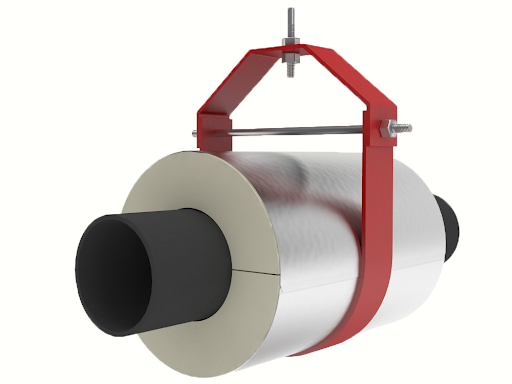
- PT&P Hot Shoes and Cold Shoes: high-temperature supports usable up to 1400°F, and cryogenic supports.
Each model also carries its own published limits. The A4000, for example, is rated by pipe size for flat-surface, pipe-roll, and clevis-hanger installation. Its standard calcium silicate insulation covers +40°F to +1200°F, and the cryogenic urethane version covers -275°F to +275°F. Load ratings are reduced at 500°F and above by a published temperature factor, and the maximum allowable travel on a pipe roll is set by the support’s dimensions.
Where the Catalog Hands You to the Factory
Beyond those limits, the factory takes over. On the A4000, temperatures up to 1800°F are available on request, and other dimensions, temperatures, and loads go to the factory for review. PT&P’s high-temperature Hot Shoes work the same way: temperatures outside the standard range are handled with the factory, and special requirements such as mill test reports, material certification, or non-standard materials must be specified before the order is placed.
That gives a simple test. When the pipe size, temperature, load, and movement all fall within the published limits for the configuration you need, a catalog model applies. When any one of them falls outside, the application needs a factory review.
Conditions That Call for Custom Engineering
PT&P adapts its standard products to a project in five main areas:
- Dimensions: almost all products can be resized to meet specific requirements.
- Load: unusual loads are handled with custom-engineered solutions, checked with in-house finite element analysis (FEA).
- Travel and movement: custom spring supports and expansion joints are designed for unusual travel requirements.
- Materials: a wide range is available, including superalloys and thin-gauge material.
- Finishes: galvanized, painted, neoprene, and paint over galvanized.
For pre-insulated supports, temperature adds another layer. Insulating a support is harder than insulating the pipe itself, because the insulation under the support has to carry the pipe’s load, and insulation’s thermal efficiency generally falls as its compressive strength rises. A pre-insulated support design has to balance those two properties against the temperature limits, the energy to be dissipated, condensation control, exposed-surface temperatures, insulation life, cost, and the space available for the support.
How the Custom Design Process Works
Custom pre-insulated supports are developed using a combination of FEA, thermal analysis, and material engineering. PT&P runs its FEA in ANSYS and pairs it with in-house manufacturing and testing, so a design can be checked at extreme loads and temperatures, such as a custom pipe clamp analyzed for service at 1015°F.
A custom job can start from either side:
- Reviewing an existing design: on an LNG project, an EPC customer’s cryogenic support design was checked with FEA and thermal analysis, then put through a cryogenic test. The customer revised the design based on the results.
- Selecting and sizing the insulation: on a chilled water line, PT&P offered insulation options and, once the customer chose one, calculated the required thickness.
Design calculations for Hot Shoes and Cold Shoes are available for review on request by the purchaser or end user. PT&P’s engineering and design services also produce 3D models for interference checks and work with plant design software such as Intergraph SupportModeler, Microstation, Intergraph PDS, and SmartPlant.
Custom work also scales to full projects. For an ammonia project in Louisiana, PT&P custom-designed 98 insulated pipe supports for both cryogenic and high-temperature lines, with standard QC and dimensional tests performed before shipment.
Check the Catalog First
Start with the series that matches how the pipe is held, then compare your pipe size, temperature, load, and movement with the published limits for that model. If all of them fall inside, the catalog model applies. If one falls outside, bring Pipe Shields in at that point, before a support is designed in-house.
Not sure whether your application is a catalog fit? Connect with our team and schedule time with an engineer to review your support point. Once the requirements are set, request a quote.
Frequently Asked Questions
How do I know if a standard Pipe Shields model will work?
Match the series to how the pipe is held, then check that your pipe size, temperature, load, and movement fall within the published limits for that model. If any one falls outside, contact the factory.
What conditions require a custom design?
Requirements outside the published ratings, such as other dimensions, temperatures, or loads, along with special materials or non-standard finishes.
Can a standard model be modified instead of fully custom designed?
Yes. PT&P states that almost all of its products can be resized to meet specific requirements, and the A4000 page lists temperatures up to 1800°F as available upon request.
Can Pipe Shields review a support design we have already developed?
Yes. On an LNG project, PT&P reviewed an EPC customer’s cryogenic support design using FEA and thermal analysis, ran a cryogenic test, and the customer revised the design based on the results
