
On a heat-traced line, the tracing has to pass every support point on the line. Pipe Shields supplies insulated pipe supports with grooves for heat tracing, so the tracing cable sits inside the support instead of being routed around it. The number and location of the grooves vary by support and are set on the design drawings. This article explains how the grooves work and what to include in your RFQ so the grooves are built in.
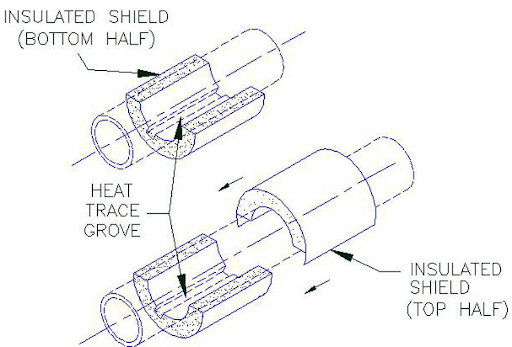
Heat Trace Grooves Are Built Into the Support
Pipe Shields handles heat tracing at the design stage. Each support can be built with one or more grooves in the shield, and the tracing cable is positioned inside the groove when the support is installed. Pipe Shields has supplied many insulated pipe supports with heat trace grooves, and adding them can be done readily and economically.
The grooves are made to the tracing details sent with the order. A support ordered with those details arrives with the grooves in place. A support ordered without them is built without grooves.
How Heat Trace Grooves Work at Support Points
Pipe Shields’ installation instructions set out three rules for supports with heat trace grooves. The number and location of the grooves can vary from one support to the next. The design drawings show the exact number and location for each support. During installation, the heat tracing cable must be positioned inside the groove of the shield.
If you’re not sure whether the model you’re specifying can take grooves, confirm with Pipe Shields before ordering.
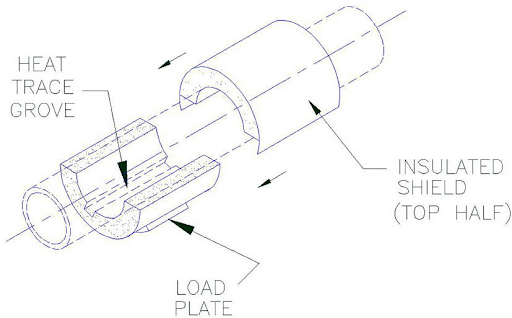
When Heat Tracing Is Left Out of the Support Design
If the tracing details aren’t in the order, the support arrives without a groove. Pipe Shields’ installation instructions cover one method only: a tracing cable seated in a designed groove, at the location shown on the drawings. They give no method for routing tracing around a support that has no groove.
If the supports on site don’t match your tracing layout, check with Pipe Shields before making any change in the field.
How to Specify Heat Tracing in Your RFQ
Every pre-insulated support order starts with six parameters, covered in what information you need to order a pre-insulated pipe support:
- Pipe size
- Service temperature
- Insulation thickness
- Load
- Support configuration
- Expected movement
For a heat-traced line, Pipe Shields asks for four more details:
- Number of heat tracing lines
- Size of the heat tracing
- Configuration of the heat tracing
- Orientation of the heat tracing
Pipe Shields’ installation instructions refer to heat tracing cable. If your line uses tracer tubing instead, state that in the RFQ and confirm the groove arrangement with Pipe Shields.
Coordinate Heat Tracing Before Ordering Supports
A pre-insulated support design already balances several factors: the temperature limits the support must handle, the energy it must dissipate, preventing condensation that would cause corrosion, keeping exposed surfaces below the maximum temperature allowed by plant safety, and the space available for the support. Sending the tracing details with your RFQ means the grooves are designed alongside these factors and shown on the drawings before installation begins.
Need to confirm a traced support point? Contact us and schedule time with an engineer. Once your tracing details are set, request a quote.
Frequently Asked Questions
Q: Can heat-trace lines be accommodated in Pipe Shields supports?
A: Yes. Pipe Shields can add grooves to accommodate heat tracing. The company has supplied many supports with heat-trace grooves and can add them readily and economically. See the heat-trace FAQ.
Q: What information is needed to add heat-trace grooves?
A: Provide the number, size, configuration and orientation of the heat-tracing lines when requesting a quote.
Q: Do all Pipe Shields supports come with heat-trace grooves?
A: Heat-trace grooves are added based on the customer’s requirements. Provide the tracing details when ordering so Pipe Shields can determine the appropriate configuration for the selected support.
