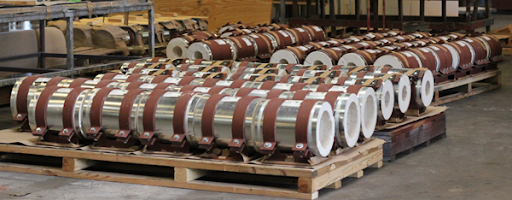
Every pre-insulated pipe support contains load-bearing insulation at the point where the pipe meets the support. That insulation carries the weight of the pipe and limits heat transfer between the pipe and the structure. Each insulation material can do both jobs only within its rated temperature range, so the service temperature of the line determines which materials can be used.
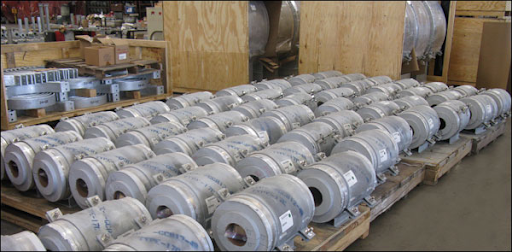
Pipe Shields uses four load-bearing insulation materials: polyurethane foam, calcium silicate, Foamglas®, and Super Fire Temp. Together, they cover service temperatures from –450°F to +1700°F. This article explains the temperature range, compressive strength, and moisture behavior of each material, and shows how service temperature narrows the choice before a quote is prepared.
Why Pipe Supports Need Load-Bearing Insulation
Along most of a line, pipe insulation only has to limit heat transfer. At a support point, it also has to carry load. The insulation sits between the pipe and the supporting structure and must resist crushing under the weight of the pipe. Standard pipe insulation is not designed for that load, so pre-insulated supports use load-bearing insulation instead.
Without load-bearing insulation, the support becomes a thermal bridge: a metal path that conducts heat directly between the pipe and the structure. The effect depends on the service:
- Hot service: heat is lost through the support, wasting energy. Under the Manufacturers Standardization Society (MSS) code, steel supports lose 100°F per inch, measured from the outer wall of the pipe.
- Cold and cryogenic service: more energy is needed to re-cool the fluid, and condensation forms at the support, which leads to corrosion under insulation (CUI).
- Exposed surfaces on hot lines: surface temperatures must stay below the maximum allowed by plant safety requirements.
The Trade-Off Between Strength and Insulation
Insulation efficiency tends to fall as compressive strength rises. Denser materials are stronger, but they generally conduct more heat. Every support insulation material is a balance between carrying the load and limiting heat transfer, and each one holds that balance only within its rated temperature range.
Pipe Shields evaluates four inputs together when selecting support insulation:
- Service temperature: the operating temperature of the line must fall within the rated range of the material.
- Load: the compressive strength of the insulation must suit the load at the support. Standard grades range from 100 psi (calcium silicate) to 500 psi (20 lb/ft³ polyurethane foam).
- Environment: moisture absorption affects both thermal performance and corrosion at the support.
- Movement: expected vertical, lateral, and axial movement at the support is a design input.
Service temperature is the input that rules materials out completely. If a material is not rated for the line’s temperature, its strength and moisture resistance do not matter. For a full breakdown of each material, see the pre-insulated pipe support materials guide.
Polyurethane Foam: Standard for Cold and Cryogenic Service
High-density polyurethane foam (PUF) is the standard insulation for cold and cryogenic pre-insulated pipe supports. Its published service range is –275°F to +275°F, and supports can be engineered for service down to –325°F.
Polyurethane foam is supplied in several densities. Higher density gives higher compressive strength and lower water absorption:
| Density | Compressive strength | Water absorption |
| 10 lb/ft³ | 200 psi | 0.22% |
| 14 lb/ft³ | 300 psi | 0.18% |
| 20 lb/ft³ | 500 psi | 0.13% |
| 35 lb/ft³ | Available on request | — |
All standard grades have 95% closed-cell content. Strength also depends on the catalyst, surfactant, mixing method, and foaming system, and the foam is stronger in the direction it rises during manufacture. PT&P, the parent company of Pipe Shields, produces its polyurethane in-house.
For cold supports, compressive strength is tested to ASTM D1621. Pipe Shields’ Cryoshoes specification requires a minimum safety factor of 5 at the system design temperature when setting the maximum load.
Calcium Silicate: Standard for Hot Service up to 1200°F
Calcium silicate (Thermo-1200/Gold) is the standard insulation for high-temperature pre-insulated pipe supports. It is a hydrous calcium silicate, and Pipe Shields uses a 14 lb/ft³ grade.
- Service temperature: +40°F to +1200°F
- Compressive strength: 100 psi
- Water absorption: less than 15%, and the insulation is treated with a water repellent
- Other properties: fire resistant, low chloride content and low corrosivity, asbestos-free
Foamglas®: Widest Temperature Range and Very Low Water Absorption
Foamglas® has the widest service temperature range of the four materials, from –450°F to +900°F, and is used on both cryogenic and hot lines. It is a lightweight, rigid insulation made of millions of completely sealed glass cells.
- Density: 8 lb/ft³
- Compressive strength: 100 psi
- Water absorption: 0.07%
- Other properties: fire protection, corrosion resistance, and long-term dimensional stability
Moisture cannot pass through the sealed glass cells as either liquid or vapor, so properly installed Foamglas® keeps its original thermal efficiency over the long term.
On heavy-duty supports, Foamglas® is not used on its own at the load point, where the pipe’s weight bears on the support. It is combined there with a load-bearing material: polyurethane for cold service, and calcium silicate or Super Fire Temp structural inserts for hot service.
Super Fire Temp: Hot Service up to 1700°F
Super Fire Temp is a high-density, high-temperature insulation rated from +40°F to +1700°F, 500°F above the limit for calcium silicate. It is used as a structural insert at the load point of hot-service supports. The insert carries the pipe load, and the surrounding insulation limits heat transfer.
How Service Temperature Narrows the Choice
The table below shows which materials are rated for each temperature band:
| Line temperature | Materials rated for the range |
| –450°F to +900°F | Foamglas® |
| –275°F to +275°F | Polyurethane |
| +40°F to +1200°F | Calcium silicate |
| UP to +1800°F | Super Fire Temp |
At the coldest and hottest ends of the range, only one material is rated. Below –275°F, that material is Foamglas®, paired with polyurethane at the load point of heavy-duty supports. Above 1200°F, it is Super Fire Temp. In the middle bands, more than one material is rated, and the final selection depends on load, environment, and movement.
Composite Insulation for Combined Requirements
When no single material meets both the temperature and the load requirement, Pipe Shields uses a composite design that combines two materials. The combination is identified by a suffix after the catalog model number:
- U: polyurethane
- UF: polyurethane with Foamglas®
- CF: calcium silicate with Foamglas®
Insulation Material Comparison
| Material | Service temperature | Compressive strength | Water absorption |
| Polyurethane foam | –275°F to +275°F | 200 to 500 psi (10 to 20 lb/ft³) | 0.13% to 0.22% |
| Calcium silicate | +40°F to +1200°F | 100 psi (14 lb/ft³) | Less than 15% |
| Foamglas® | –450°F to +900°F | 51 psi (8 lb/ft³) | 0.07% |
| Super Fire Temp | +40°F to +1700°F | High-density structural insert | — |
What to Include in Your RFQ
Because the insulation must be rated for the line’s temperature, the temperature you send with your RFQ determines which materials are possible. Send it with the other inputs covered in what information you need to order a pre-insulated pipe support: pipe size, insulation thickness, load, support configuration, and movement.
Not sure which insulation your line needs? Connect with our team and schedule time with an engineer. Once your service conditions are set, request a quote.
Frequently Asked Questions
What insulation is used in cold and cryogenic pipe supports?
High-density polyurethane foam is the standard, rated –275°F to +275°F, and supports can be engineered for service down to –325°F. Foamglas® is rated to –450°F and is combined with polyurethane at the load point.
What insulation is used in high-temperature pipe supports?
Calcium silicate is the standard, rated from +40°F to +1200°F. Above 1200°F, Super Fire Temp is used as a structural insert, rated to +1700°F.
What is the compressive strength of pipe support insulation?
Compressive strength varies from 100 psi and above depending on insulation type
Which pipe support insulation absorbs the least moisture?
Of the materials with published figures, Foamglas® has the lowest water absorption, at 0.07%. Its sealed glass cells keep out moisture in both liquid and vapor form.
Does high temperature reduce a pipe support’s load rating?
No, we can have custom design for HT and large loads as much as insulation material can handle
What do the U, UF, and CF suffixes mean on Pipe Shields models?
U designates polyurethane, UF designates polyurethane with Foamglas®, and CF designates calcium silicate with Foamglas®.